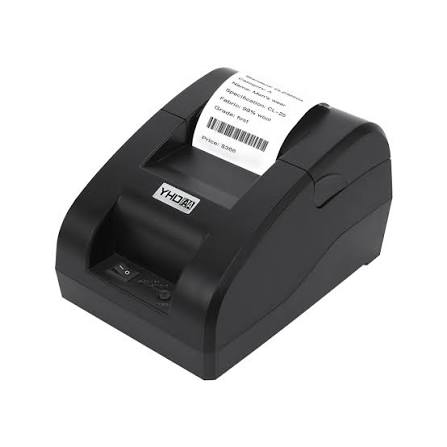
Receipt printers are essential tools for businesses that need to generate transaction records, customer bills, and order information quickly. From supermarkets and retail stores to restaurants and hospitality businesses, these devices support efficient payment processing and organized daily operations. However, selecting the right printing technology can make a significant difference in performance, maintenance, and operating costs.
Two of the most widely used technologies are thermal and impact printing. Each offers specific advantages depending on the working environment and business requirements. Understanding how these technologies differ can help businesses choose a suitable Receipt Printer for their operations.
Understanding Thermal Receipt Printers
Thermal receipt printers use heat to create text and images on specially coated thermal paper. A heated printhead applies controlled heat to the paper surface, producing the required characters and graphics.
Unlike conventional printers, thermal models do not require ink cartridges, toner, or printing ribbons. This makes them convenient for businesses that process numerous transactions throughout the day.
Key Benefits of Thermal Printing
1. Fast Printing Performance
Thermal printers are designed to produce receipts quickly. Their high printing speeds make them suitable for busy checkout counters, supermarkets, cafes, and restaurants where customers expect minimal waiting times.
2. Quiet Operation
Since thermal printing does not involve mechanical pins striking an ink ribbon, these devices generally operate more quietly than impact printers. This is beneficial in customer-facing environments where noise reduction is important.
3. Lower Routine Maintenance
Thermal printers do not require traditional ink or ribbon replacements. Employees generally need to replace the paper roll and perform basic cleaning to maintain consistent performance.
4. Compact Design
Many thermal printers feature compact structures that fit easily on checkout counters, restaurant workstations, and kiosks.
Limitations of Thermal Printers
Despite their advantages, thermal printers have certain limitations. They require specially coated paper, which may be affected by excessive heat, sunlight, and other environmental conditions.
Printed receipts may also fade over time, making thermal printing less suitable for documents that require long-term physical preservation without additional storage methods.
Understanding Impact Receipt Printers
Impact receipt printers, commonly known as dot matrix printers, use mechanical pins to strike an ink ribbon against paper. These impacts create characters and graphics through physical contact.
This technology has been used for many years in commercial environments, particularly where businesses require multiple copies of transaction documents.
Key Benefits of Impact Printing
1. Multiple Copy Printing
One of the biggest advantages of impact printers is their ability to print on multi-part paper. This allows businesses to create duplicate or triplicate copies of receipts and order tickets simultaneously.
2. Suitable for Demanding Environments
Impact printers can be useful in certain environments where heat-sensitive paper may not be ideal. Some models are designed for commercial kitchens and other demanding operating conditions.
3. No Dependence on Thermal Paper
These printers use standard compatible paper and ink ribbons rather than specially coated thermal rolls. This provides flexibility for businesses that already use multi-part paper systems.
4. Practical for Kitchen Operations
Restaurants sometimes prefer impact printers for kitchen order tickets because they can produce clear printed instructions and duplicate copies when needed.
Limitations of Impact Printers
Impact printers generally operate more slowly than thermal models and produce noticeable mechanical noise. They also require periodic ribbon replacement and additional maintenance.
Their mechanical printing process can make them less convenient for businesses that prioritize quiet operation and high-speed checkout transactions.
Thermal vs. Impact Receipt Printers: Main Differences
Although both technologies produce printed transaction records, their operating methods and performance characteristics differ.
| Feature | Thermal Printer | Impact Printer |
|---|---|---|
| Printing method | Heat-sensitive paper | Mechanical pins and ink ribbon |
| Printing speed | Generally faster | Generally slower |
| Noise level | Quiet | Relatively noisy |
| Consumables | Thermal paper | Paper and ink ribbons |
| Multiple copies | Usually not supported directly | Supports multi-part paper |
| Maintenance | Generally lower | Requires ribbon and mechanical maintenance |
| Common applications | Retail and checkout counters | Restaurant kitchens and duplicate receipts |
| Print durability | Sensitive to heat and environmental conditions | Depends on ink, paper, and storage conditions |
The most appropriate technology depends on the type of documents a business needs to produce and the environment in which the printer operates.
Which Technology Is Better for Different Industries?
Different businesses have different printing requirements, so neither technology is universally better.
Retail Stores and Supermarkets
Thermal printers are generally the preferred option for retail businesses. Their fast printing speeds, quiet operation, and convenient maintenance make them suitable for busy checkout counters.
They can also integrate with modern POS systems to generate customer receipts immediately after payment.
Restaurants and Cafes
Restaurants may benefit from both technologies. Thermal printers are useful for customer bills and front-counter transactions, while impact printers can be suitable for kitchen order tickets and situations requiring duplicate copies.
Hotels and Hospitality Businesses
Thermal printers are commonly used at hotel reception desks, payment counters, and restaurant billing stations. Their compact design and quiet operation support professional customer-facing environments.
Warehousing and Industrial Operations
Some industrial and commercial environments require duplicate transaction records or printed instructions. Impact printers may be useful when their multi-part paper capabilities match these requirements.
Factors to Consider Before Choosing a Technology
Before investing in a receipt printer, businesses should evaluate several important factors.
Transaction volume: High-volume checkout environments generally benefit from the speed of thermal printing.
Document requirements: Businesses requiring duplicate or triplicate copies should consider impact technology.
Operating environment: Temperature, dust, moisture, and noise requirements can influence the selection.
Maintenance costs: Consider paper expenses, ribbon replacements, cleaning, and servicing.
POS compatibility: Ensure the printer supports the existing POS software, operating system, and connection methods.
Long-term requirements: Evaluate expected printing volume, replacement part availability, and equipment durability.
Considering these factors can help businesses avoid unnecessary expenses and select a printing solution that supports their workflow.
Future Developments in Receipt Printing
Receipt printing technology continues to improve as businesses adopt more advanced POS systems and automated payment solutions.
Thermal printers are benefiting from improved connectivity, faster printing mechanisms, and more compact designs. Wireless options such as Bluetooth and Wi-Fi are also making installation more flexible.
Impact printers continue to serve specialized applications where multi-part printing remains necessary. Although their use is more limited in some modern retail environments, they still provide practical value for businesses with specific documentation requirements.
Conclusion
Thermal and impact receipt printers both offer useful features, but their advantages depend on business requirements. Thermal technology is generally better for fast, quiet, and convenient receipt printing in retail and hospitality environments. Impact technology is more appropriate when businesses need duplicate copies or require printing on multi-part paper.
Before making a decision, organizations should compare printing speed, consumables, maintenance requirements, operating conditions, and document needs. Selecting the right technology can improve transaction efficiency, simplify daily operations, and provide reliable printing performance over time.